Bryn Mawr College funded 92 students for 10-week research stipends during summer 2026, sending undergraduates into chemistry labs, Utah's desert canyons and a Smithsonian wetland research site.
Students worked under faculty mentors across the sciences and mathematics, according to a college announcement. Projects spanned solar-cell materials, Rocky Mountain geology and brain-activity research on aging and deception. The program also included professional development workshops and a poster session where students presented findings to the college community.
In the chemistry department, Assistant Professor Eugenia Vasileiadou's lab focused on designing materials at the atomic level for cleaner energy. Lucie Burgess, a junior chemistry major, researched fluoride-ion batteries and plans to apply to Bryn Mawr's combined bachelor's-and-master's bioengineering program with the University of Pennsylvania. Fellow junior Leena Dzemaili studied silver telluride quantum dots for potential biomedical imaging.
"What you learn in the classroom doesn't always exactly translate to what happens in a lab," Dzemaili said. "It's good to get that experience."
Monica Anderson, a senior, prepared colloidal quantum dot samples for luminescence measurements using a new fluorimeter that measures light into the near-infrared spectrum. Aden Noor, also a senior, prepared perovskite crystals for the same instrument.
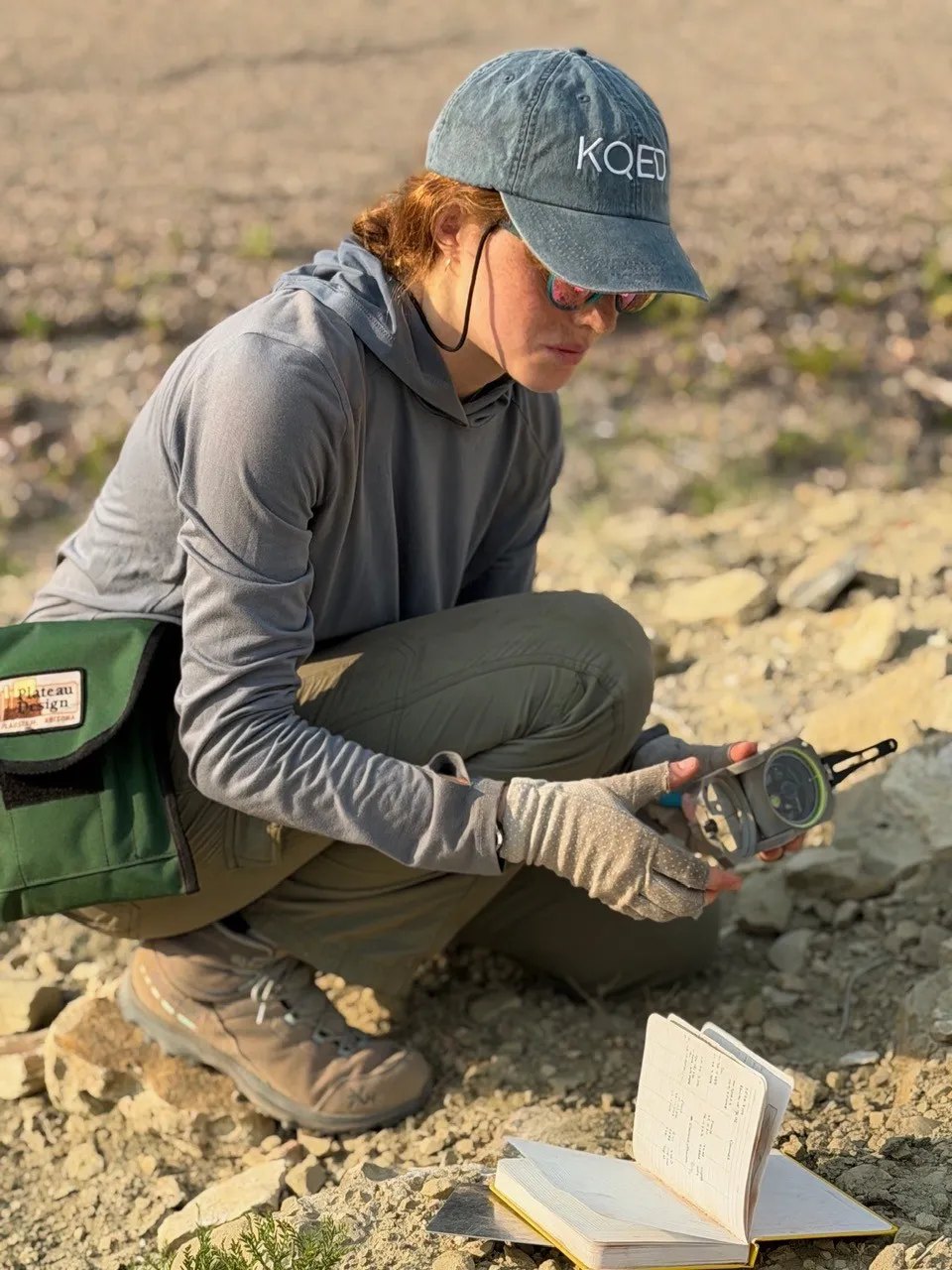
In geology, Professor Arlo Weil and junior Ava Purser spent two weeks in the Utah desert sampling Triassic red sandstones and Jurassic limestones. They measured features in the rock that indicate the direction of tectonic forces 70 million years ago and collected core samples to analyze whether the mountains experienced rotation as they formed. The data will feed multiple papers on the tectonic history of the Rocky Mountain four-corners region.
In the Bi-College Neuroscience Program, a collaboration between Bryn Mawr and Haverford College, Professor Anjali Thapar mentored two seniors. Thapar has guided summer researchers for more than 20 years. Ciara Grimes, in her second summer with Thapar, ran eye-tracking experiments that will form the basis of her senior thesis. Her prior summer work used electroencephalography (EEG) to examine brain activity associated with lying, which led to new questions about detecting deception through eye movement.
Rebecca Rothstein-Epp analyzed EEG data comparing brain responses to sounds and smells in older and younger adults, exploring whether those responses could serve as a biomarker for cognitive decline.
Five students also traveled to the Smithsonian Global Change Research Wetland in Maryland with Professor of Biology Thomas Mozdzer. The site hosts the world's longest-running elevated atmospheric CO2 experiment. Mozdzer has brought dozens of Bryn Mawr students there since joining the faculty in 2012 and runs what the college describes as the only field experiment simultaneously examining elevated CO2 and nutrient enrichment on the invasive common reed, Phragmites australis.
Stipend amounts and the total program budget were not disclosed. Faculty mentors also received stipends.
Among the wetland research group was Dakarai Lindsay, a Haverford College senior who said the experience nurtured a growing passion for evolutionary biology and opened doors to a career in environmental and conservation research. Geology student Purser heads to the University of Oxford in October for a year-long study abroad through a Bryn Mawr partnership.