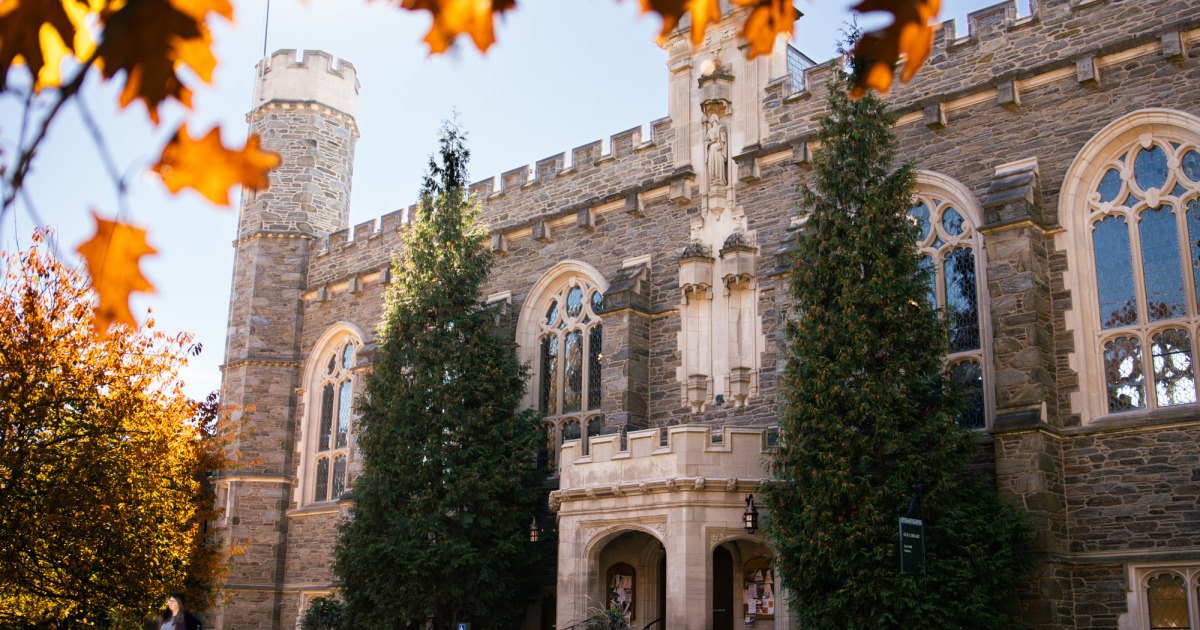
Bryn Mawr College will begin locking academic buildings with card readers during fall break, explicitly designating those spaces as off-limits to Immigration and Customs Enforcement agents and outside law enforcement.
The college announced the three-phase rollout in a Tuesday, Oct. 6 message to students, faculty and staff signed by Christopher Barth, vice president and chief information officer, and Constance A. Jones, director of libraries. Installation starts the week of Tuesday, Oct. 13 in Old Library.
Anyone without a college-issued OneCard will not be able to enter locked academic and administrative buildings. That includes federal immigration agents visiting the 135-acre Lower Merion Township campus. All residence halls already have card readers.
Barth and Jones said the card-reader expansion supports the college's efforts to designate certain campus spaces as off-limits to visiting ICE agents and outside law enforcement. The message did not cite a specific legal authority for the policy or explain how the college would enforce it if agents presented a warrant.
Three phases, one academic year
Phase one covers Old Library and Carpenter Library, Park Science, and the John Maloney Campus Safety buildings. Phase two adds Helfarian, Wyndham Alumnae House, Phebe Anna Thorne School and Ward. Phase three includes Cartref, English House, remaining unlocked doors in Erdman and West House.
The college expects to finish all three phases by the end of the 2026–27 academic year. No specific completion dates for phases two and three have been announced.
Facilities Services will contact faculty and staff in each affected building before the new card readers go live. The college urged everyone to keep their OneCard handy while moving across campus.
Additional security steps
The card-reader expansion follows other security measures Bryn Mawr introduced this fall. The college added a small number of perimeter security cameras over the summer and held a community forum on campus safety Sept. 24 in the Campus Center.
Bryn Mawr enrolls 1,288 undergraduates. Thirteen percent are international students from 40 countries, a population that could face heightened scrutiny under federal immigration enforcement.
The college has not announced when the first card readers will be activated after installation or whether visitors will need an escort to enter locked buildings.